
AI and the Legal Profession: Navigating the Risks and Opportunities
Artificial intelligence has rapidly moved from a futuristic concept to a reality that lawyers encounter in their day-to-day work.
The relationship between AI and the legal profession is evolving quickly, raising new opportunities as well as complex ethical and privacy questions.
AI tools such as generative chatbots and legal AI software are increasingly used to assist with tasks, including document review, drafting, and summarising large volumes of information. The rapid adoption of these tools in law firms underscores the pace at which technology is being integrated into legal practice. According to the Australian Financial Review (2026), major firms, including Allens, MinterEllison, Ashurst, and King & Wood Mallesons, are already using specialised legal AI platforms, such as Harvey and Legora, to assist with tasks including drafting documents, summarising judgments, and conducting due diligence.
At the same time, courts, professional bodies, and regulators are beginning to issue guidance on how AI should be used responsibly within legal practice. For example, the Law Society of NSW, the Legal Practice Board of Western Australia, and the Victorian Legal Services Board and Commissioner have put forward common principles to guide the responsible use of AI.
So what does this mean for the legal profession?
Like many technological shifts before it, AI presents both challenges and opportunities. While it may change how some legal work is performed, it is also creating new ways for lawyers to deliver value to clients.
Below, we explore three potential threats and three opportunities AI may present for the profession.
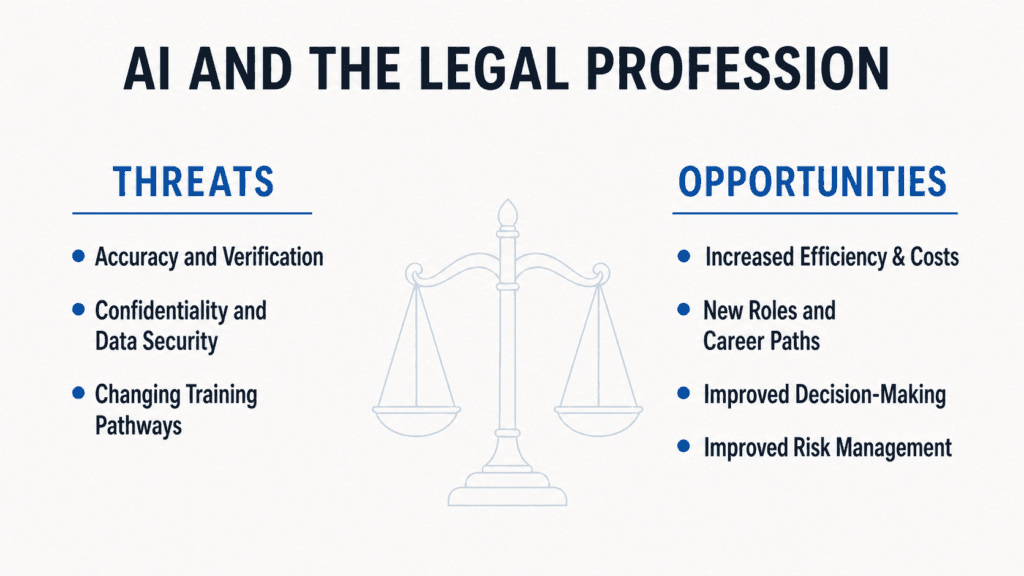
THREAT 1 – Accuracy and Verification
AI tools can sometimes produce convincing but incorrect information — a phenomenon commonly referred to as “hallucinations.” This may include fabricated case law, incorrect legal principles, or misinterpretation of authorities.
Unlike traditional search engines, which link users directly to source material, generative AI tools interpret a user’s prompt and produce conversational responses based on patterns in large datasets. While this can produce helpful summaries or drafts, the output is not always tied to verifiable sources.
Importantly, generative AI cannot understand legal context in the way a lawyer does. It cannot identify who the client is, weigh competing interests or exercise professional judgement. For this reason, AI-generated work must always be independently verified by a legal practitioner. This is particularly important given that, according to JurisTechne, a legal technology company reporting in Lawyers Weekly (2026), hallucination risks may extend beyond individual chatbot responses and affect the legal data relied upon by AI systems.
This risk has already appeared in court. In Re Walker [2025] VSC 714, a solicitor used AI while preparing opening submissions. Justice Moore identified several authorities that were simply made up by AI trying to please its users. The solicitor was reprimanded, reinforcing that AI-assisted work must be thoroughly checked before being filed. Last year, Deloitte was forced to refund $440,000 to the Department of Employment and Workplace Relations for errors in a report partly produced by AI.
THREAT 2 – Confidentiality and Data Security
Another major concern surrounding the use of generative AI in legal practice is the risk to client confidentiality and data security.
Many AI tools operate through cloud-based systems, meaning information entered into the platform may be processed or stored by external providers. The Law Society of New South Wales has warned that, like any publicly available online tool, generative AI systems may be vulnerable to data breaches and may not consistently implement robust data anonymisation practices.
There is also a risk that confidential information could be exposed by the design of certain systems. Many generative AI tools improve by learning from user prompts, meaning information entered into the system may be retained or used to further train the model.
The Victorian Law Reform Commission has similarly noted that AI systems can analyse personal information and draw conclusions beyond the purpose for which that data was originally collected. As a result, strong safeguards and human oversight are essential when using AI in legal practice.
THREAT 3 – Changing Training Pathways
AI may also reshape how junior lawyers develop their skills.
Traditionally, the early years of legal practice involve tasks such as legal research, drafting first documents, preparing chronologies and reviewing large volumes of material. These tasks have historically constituted the “apprenticeship” stage of a legal career, enabling junior lawyers to develop legal reasoning, attention to detail and familiarity with case law.
However, many of these tasks can now be completed more quickly with the assistance of AI tools. According to the Australian Financial Review (2026), large law firms are increasingly using specialised AI platforms to assist with tasks such as drafting correspondence, summarising judgments, conducting legal research and reviewing large sets of documents during due diligence or litigation discovery. These are tasks that have traditionally formed a significant portion of junior lawyers’ workloads. Anecdotally, some firms have hired fewer clerks and graduates, although AI may not be the only factor.
As a result, the growing use of AI may change the nature of early legal training. The Australian Financial Review (2026) also reports that AI is likely to reshape the first years of a young lawyer’s career, as junior lawyers may no longer spend significant time on routine tasks such as drafting repetitive correspondence or processing revisions to legal documents. In the past, junior lawyers were also responsible for administrative tasks such as photocopying, indexing and fact-checking complex legal materials, which formed part of their early training. As technology continues to automate these functions, some commentators suggest universities and law schools may need to ensure graduates enter practice with stronger practical skills and a greater level of work readiness.
OPPORTUNITY 1 – Increased Efficiency & Costs
One of the most widely recognised benefits of AI in legal practice is its ability to improve efficiency and streamline workflows.
AI systems are capable of processing large volumes of data and producing analysis far more quickly than humans. They also create opportunities to automate tasks that involve high levels of repetition and limited discretion, including certain administrative and case management processes.
Industry reports also suggest AI can deliver measurable productivity benefits. The Clio Legal Trends Report (2025) found that more than a third of firms reported increased revenue attributable to AI use, while nearly 70% of heavy adopters reported financial gains. By automating routine tasks and improving workflow efficiency, AI can also help law firms better manage costs and offer more competitive pricing to clients. This may be particularly beneficial for smaller firms, as AI tools can provide access to capabilities that were previously available only to larger firms with greater resources.
At the same time, these efficiency gains may reduce the cost of producing certain legal services. Potentia Capital’s Andrew Gray, a Sydney-based private equity investor in software businesses, suggested in the Australian Financial Review (2026) that the cost of producing some legal advice could fall to around one-quarter of its current level, while the fees charged to clients for that work may fall by as much as half as AI reduces the labour required to complete routine legal tasks. This may be particularly beneficial for smaller firms, as AI tools can provide access to capabilities that were once available only to larger firms with greater resources.
OPPORTUNITY 2 – New Roles and Career Paths
Another opportunity created by the rise of AI is the emergence of new roles and career pathways within the legal industry. As law firms adopt new technologies, they increasingly require professionals who can bridge the gap between legal expertise and technological systems.
Examples of emerging roles include:
- Legal Technologists – professionals who help implement legal technology, automate workflows and improve the efficiency of legal services.
- Legal Data Analysts – specialists who analyse legal data, identify patterns and extract insights to support legal strategy and decision-making.
- AI Compliance Officers – professionals responsible for managing the legal, ethical, and regulatory risks associated with the use of AI within organisations.
- AI Lawyers or Specialists – lawyers who advise clients on AI governance, regulation, risk management and responsible adoption of emerging technologies.
These roles demonstrate how AI is not only changing how legal work is performed but also expanding the range of career opportunities within the legal profession.
OPPORTUNITY 3 – Improved Decision-Making and Risk Management
When used responsibly and with appropriate human oversight, AI can support more informed, data-driven decision-making in legal practice. AI systems can assist with organising and managing large volumes of information, including client data, court deadlines and legal documentation, helping firms maintain more structured and reliable processes.
AI tools can also reduce the risk of oversight by applying consistent standards when reviewing documents. For example, in contract analysis, AI systems can identify unusual terms, missing clauses or potential compliance risks that may otherwise go unnoticed during manual review. Philip Evangelou, Managing Director of a Sydney-based law firm, noted on the LawLive podcast (Episode 54.5) that combining AI with tools such as contract management systems can help legal teams better manage risk and streamline internal processes, enabling lawyers to review information more efficiently while maintaining appropriate oversight.
In addition, AI systems can analyse historical case outcomes and legal trends, helping lawyers assess the potential risks of different legal strategies or better anticipate how a matter may progress. By analysing client data, AI may also help firms identify patterns in client needs and preferences, allowing them to tailor their services and improve the overall client experience.
So, is AI a threat or an opportunity for the legal profession?
In reality, it is both. AI has the potential to significantly improve efficiency, support better decision-making and create new opportunities within the legal industry. At the same time, it raises important considerations regarding accuracy, confidentiality, and the way lawyers are trained. These developments highlight an important point: while AI may assist with certain tasks, it cannot replace the professional judgement, ethical responsibility and contextual understanding that underpin legal practice.
Rather than viewing AI purely as a threat, it may be more accurate to see it as a tool that will reshape how legal services are delivered. Like previous technological shifts within the profession, its impact will ultimately depend on how it is used. With appropriate safeguards, clear policies and ongoing human oversight, AI can support lawyers in delivering more efficient and effective services while maintaining the standards expected of the profession.
How Does This Impact Lawyers Looking For Jobs?
Importantly, these changes are also beginning to influence the legal job market. As firms adopt new technologies, they are increasingly seeking lawyers who are adaptable, commercially minded and comfortable working alongside AI tools. Emerging roles and evolving skill requirements mean that both candidates and employers must stay informed to remain competitive. For legal professionals, understanding how AI is shaping the profession is no longer optional. It is becoming a key part of career development and job readiness.
For more information, contact Jason Elias at 0411 151 860