
The Big Stay: Why Lawyers Are Reluctant to Move Jobs in 2026
Across Australia’s legal market, hiring is still happening — but movement is slower and more cautious than ever.
Many lawyers are gainfully employed, reasonably well-paid, and not convinced that changing firms is worth the risk right now.
For employers, that means:
- The active candidate pool is smaller
- Time-to-fill stretches out
- The sale shifts from “why join” to “why leave”
This caution isn’t just a feeling. Gartner’s Global Talent Monitor (Australia, Q4 2025) found job market confidence fell to 55.7 (a three-year low), and only 19.4% of employees said they were actively seeking a new role.
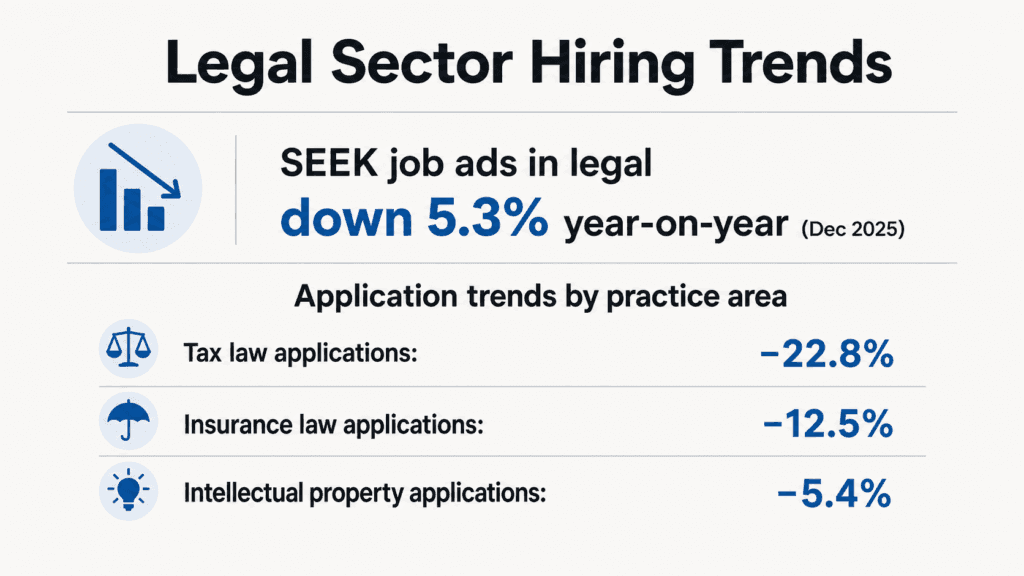
Legal sector data tells a similar story. SEEK reported a 5.3% year-on-year decline in legal job advertisements in December 2025, reflecting a slightly softer hiring environment.
Application trends are also uneven across practice areas. While increases are being seen in legal support roles and some practice areas, applications for several specialist lawyer positions have declined significantly, including tax law (-22.8%), insurance law (-12.5%) and intellectual property (-5.4%) compared to the same time last year.
Even where application numbers have increased, employers report that the main challenge remains a shortage of suitably experienced and high-quality candidates. For employers, this creates a familiar paradox: vacancies still exist, but the pool of experienced lawyers actively applying for roles remains tight, reinforcing the “Big Stay” dynamic.
What’s driving the “Big Stay”?
The themes are consistent across the legal industry. Cost-of-living pressures and economic uncertainty are leading lawyers to prioritise stability, and many are comfortable where they are thanks to hybrid routines, stable teams and known managers.
Remote and hybrid working have also removed some traditional triggers for job moves. Historically, lawyers often changed firms due to long commutes, rigid office expectations or management friction. With many lawyers now working remotely two or more days a week, some of those pressures have softened. Retention strategies have also strengthened. Clearer promotion pathways, development opportunities and improved benefits have made it easier for firms to keep their talent.
The hiring landscape has also shifted from the peak lateral hiring surge seen during the COVID years. At that time, firms frequently offered generous financial incentives to attract lawyers amid intense demand. As the market has normalised, those incentives have become less common, meaning the financial upside of moving firms is not as compelling as it once was.
Gartner describes this dynamic as a labour market “freeze”, where employees feel hesitant to leave but also unsure what the market can offer.
What changes in sourcing behaviour?
- Fewer active applicants; more passive talent work
Many firms are seeing weaker responses to job advertisements, both in volume and fit. A higher proportion of applicants may be overseas-qualified or too junior for what the role requires, while lawyers with 3+ years’ PQE are genuinely hard to find. When they do come up, they usually have multiple options. Job boards alone are becoming less reliable as a primary sourcing channel. Quality candidates rarely apply directly, and when they do, they are often already speaking with several firms.
What works better in 2026:
- Targeted outreach (not “spray and pray”).
- Referrals and alumni networks.
- Re-engaging warm leads.
- Revisiting “silver medalists” (great candidates who came second last time).
In this climate, databases and relationship capital often outperform job board spend.
- Motivations shift from “career leap” to “risk-managed move”
When lawyers are comfortable, they rarely move for vague upside. They move for certainty.
Candidates want clear answers to practical questions:
- What success looks like in the first 90–180 days
- Who they report to and how that manager operates
- Whether the pipeline and budget are stable
- What flexibility actually looks like in practice
Compensation, work-life balance and flexibility remain the trifecta of top candidate concerns. This aligns with broader workforce signals. Gartner reports employees are increasingly opting for security over risk as job market confidence drops.
- Employer risk signals matter more
In a cautious market, candidates scrutinise details they might previously have ignored, including restructure history, leadership churn, ambiguous reporting lines, shifting stakeholders and “new” roles with unclear scope. They also pay closer attention to probation expectations, billings targets and management style. In tight professional circles like Australia’s legal market, reputation travels quickly, and candidates will quietly validate what they hear.
How do you get lawyers interested in your opportunity?
The simple mindset shift: Make the offer feel safer, not just bigger.
- De-risk the move (economic uncertainty)
Start by making the “why” of the hire obvious. Candidates want to understand what’s happening in the team, why the role exists now, and what’s stable around it (pipeline, budget, client base). When you can connect the role to something tangible like revenue, delivery or risk reduction, the move feels less like a gamble.
- Make the flexibility crystal clear (remote-work comfort)
If flexibility is part of the offer, treat it as a core feature, not a vague perk. Spell out the model early and in writing, including days in office, core hours, team cadence and any travel expectations, so there are no surprises later.
- Sell sustainability (burnout recovery)
Many lawyers aren’t looking for “more” right now; they’re looking for manageable. Instead of relying on slogans about culture, talk to the practical realities of the workload and how it’s managed. Details like team size, how matters are allocated, what peak periods look like, and what after-hours expectations really are help candidates picture the role and trust that it’s sustainable.
- Offer a learning story (AI disruption)
AI is beginning to reshape parts of legal work, particularly at the junior level. Some firms are already reconsidering the size of their clerkship and graduate intakes as automation evolves. Position the role as capability-building. Be clear about training, learning support and the tools the team is actually using.
Why the hiring process matters more when movement slows
When candidates are cautious, they read your process as a proxy for culture. Four areas that win in 2026:
- Speed with dignity: reduce time between stages, give prompt feedback, and reduce “maybe loops”. As they say, time kills deals.
- Transparency: salary range, flexibility model.
- High signal interviews: structured questions, job-relevant tasks, clear scoring.
- Closing discipline: references, approvals, and offer steps lined up early to avoid losing candidates in delays.
Conclusion
The Big Stay reflects a legal workforce that is cautious rather than disengaged. Lawyers are still open to opportunity, but the threshold for moving has risen. Comfort, flexibility and known environments now compete directly with the potential upside of a new role.
Most lawyers are reasonably well paid, comfortable with their teams, and benefiting from flexible working arrangements that didn’t exist a few years ago. That means the bar for moving has quietly risen. The promise of something “better” is no longer enough on its own.
For more information contact Jason Elias 0411151860